By Paula
Discovering the coral world
I never truly understood how extraordinary corals are until I started diving in Gili Air. I knew they were animal and not rocks, but I hadn’t realised how diverse, complex and vital they are to ocean life. Every dive here feels like stepping into another world.
Joining the Research Assistant Programme in Gili Air has opened my eyes to this world in a way that no textbook ever could. Seeing corals up close, learning how they grow, feed and interact with countless marine species has made me appreciate their beauty and importance more deeply than I ever imagined.
The hidden diversity of corals
Corals come in an incredible variety of shapes, colours and forms. There are estimated to be more than 600 different species, and about 76% of them are found in the Coral Triangle, which includes countries such as the Philippines, Malaysia, Indonesia, Timor-Leste, Papua New Guinea and the Solomon Islands. This area is a global priority for marine conservation because coral reefs act as true hotspots of marine life. That is why Gili Air is such a fantastic place to study and discover coral species, right in the heart of one of the most diverse reef systems on Earth.

Figure 1. Distribution of coral species richness within the Coral Triangle, which is home to the highest coral diversity in the world. From Veron, Stafford-Smith, DeVantier et al., (2015).
Corals are colonies of tiny animals called polyps, each surrounded by a hard calcium carbonate skeleton that together forms the reef’s structure. Within their tissues live microscopic algae known as zooxanthellae, which provide the coral with energy through photosynthesis and give them their brilliant colours. This close symbiotic relationship is vital for coral growth and reef productivity.

Figure 2. Anatomy of a coral polyp showing its main structures and symbiotic algae (zooxanthellae). From “Coral Bleaching” by Pappas M. (2020).
Caring and protecting our corals
Despite how wonderful corals are, they are under serious threat, and every year many reefs are lost to bleaching events. During these events, corals lose their algae, which also means they lose their colour, leaving them in a very vulnerable state.
Figure 3. Example of a bleached coral colony showing the loss of colour caused by the expulsion of symbiotic algae (zooxanthellae) during a bleaching event.
Many scientists and research centres around the world are currently working hard to fight this problem and carry out vital conservation research to prevent the loss of our coral reefs. Researchers are developing coral nurseries and restoration programmes, studying coral genetics to identify heat-resistant species, and testing innovative techniques to restore reef ecosystems. For instance, scientists in Australia’s Reef Restoration and Adaptation Programme are selectively breeding corals that can survive warmer seas, projects in the Maldives are using 3D-printed reef structures to provide new surfaces for coral growth, and researchers in Hawai‘i are experimenting with microfragmentation techniques to speed up coral recovery.
However, you do not need to be a scientist to make a difference. Everyone can play a part in protecting corals, and in doing so, help safeguard our oceans and our planet. By practising good buoyancy, avoiding contact with the reef, using reef-safe sunscreen and supporting local conservation projects, we can help reduce stress on coral ecosystems.
Also, as a Sharkie in the Gili Shark Team, I get to take part in coral ID workshops, learn about coral reproduction and spawning, join coral restoration dives, visit coral nurseries and help clean the structures.
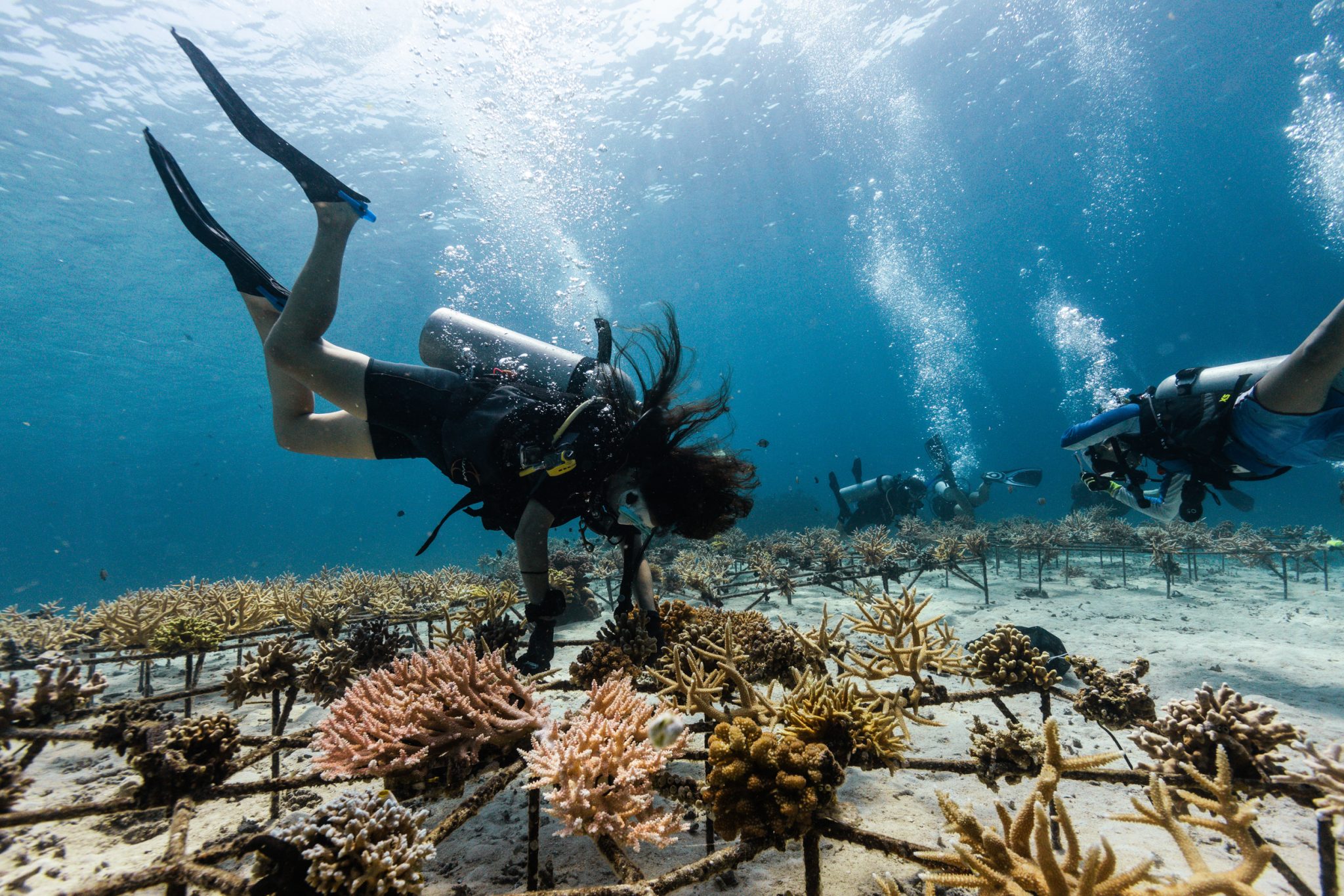
Figure 4. Sharkie working on coral restoration at the Hans Reef dive site in Gili Air.
Being part of the Gili Shark Team and seeing how much passion and dedication everyone has put into their work has been truly inspiring. I have learnt that even small actions can have a real impact and diving with a conservation purpose has not only made me a better diver but has also given me a deeper connection to the ocean. It feels incredibly rewarding to know that each dive contributes to protecting our planet and its marine life.
References
Veron, J.E.N. et al. (2009) ‘Delineating the coral triangle’, Galaxea, Journal of Coral Reef Studies, 11(2), pp. 91–100. doi:10.3755/galaxea.11.91.
Pappas M (2024) ‘Coral Bleaching’, Emerging Creatives of Science, 18 May. Available at: https://www.emergingcreativesofscience.com/post/coral-bleaching.
Muller-Parker, G., D’Elia, C.F. and Cook, C.B. (2015) ‘Interactions between corals and their symbiotic algae’, Coral Reefs in the Anthropocene, pp. 99–116. doi:10.1007/978-94-017-7249-5_5.
AIMS (2023) Breeding temperature tolerant corals for reef restoration and adaptation, Reef spawning research at AIMS. Available at: https://www.aims.gov.au/research-topics/featured-projects/reef-spawning-research-aims/breeding-temperature-tolerant-corals-reef-restoration-and-adaptation.
Maldives Independent (2018) 3D printing technology to aid coral growth in Maldives, Enviroment. Available at: https://maldivesindependent.com/environment/3d-printing-technology-to-aid-coral-growth-in-maldives-140073
Kauaʻi Coral Nursery (2025) Restoration via Microfragmentation, Methodology: Kauaʻi Coral Restoration Nursery (KCRN). Available at: https://www.kauaicoralrestoration.com/methodology
