By Nujoud
In nature, even beauty is a shield. Shells wear intricate patterns not for ornament alone, but for survival—a reminder that what dazzles the eye can also be a strategy of resilience. One afternoon, sitting in the kitchen at the Gili Shark Conservation headquarters, I picked up a book on shells from the shelf. I didn’t expect it to spark a wave of thoughts about the patterns of survival, and how survival is not always beautiful at first glance—yet beauty so often grows from survival.
I’ve long been fascinated by the precision of shells: the spacing of each stripe and dot, the palette of colours that feel perfectly calculated. I recently learned these magnetic hard structures are not decorative at all. They are camouflage, mimicry, and protection. How fascinating that first impressions—so often judged superficially—are actually windows into far more complex strategies of life.
Holding that book felt like opening a manual of survival—nature’s lessons written in colour and form. Shells are not just art, they are teachers of defence. Which led me to wonder: what exactly do these designs do?

Shells, I came to see, are never painted by chance. Their stripes, dots, and spirals are scripts written over millions of years. A mottled shell can vanish against sand or rock so well that a predator’s eye simply passes over it. Others use bold zigzags and bands to break their outline, confusing anything in search of a neat target. Some even mimic coral rubble or seaweed shadows, disguising themselves completely. Beyond concealment, colour protects against heat and sunlight in shallow waters. Lighter shells thrive on bright reefs, while darker ones survive where shadows linger. What looks like ornament is, in truth, resilience—an artistry born from necessity.
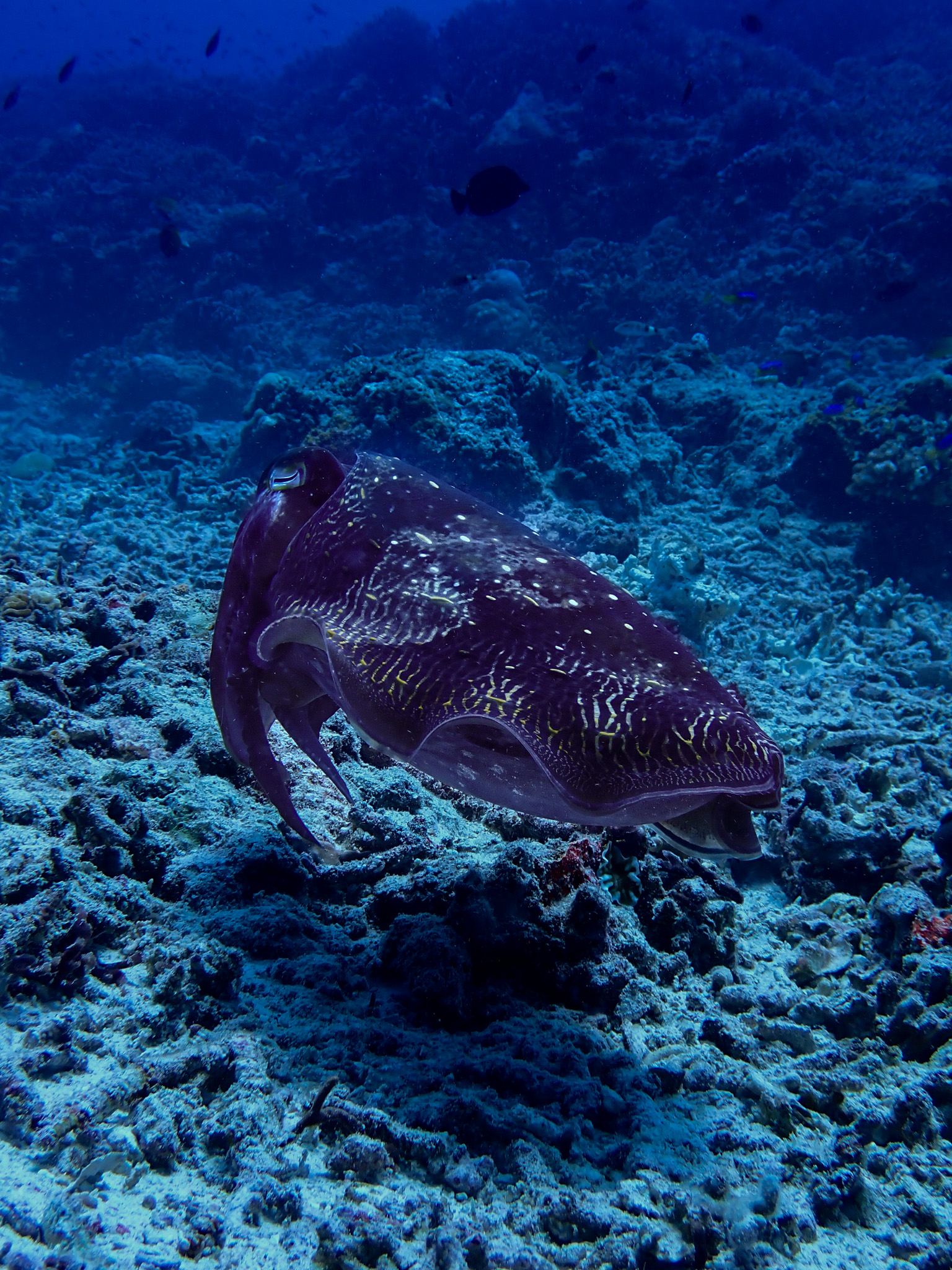
If shells are survival written in stone, cephalopods are survival in motion. Seeing a cuttlefish for the first time felt unreal, like watching liquid light. Its body shimmered, colours rippling across its skin in perfect synchrony with the reef. One moment it was beige, vanishing into the seabed, the next it flashed iridescent waves that left me transfixed. This shifting isn’t just beauty—it’s language, camouflage, and defence all at once.
Later, I saw octopuses mating for the first time. What struck me was how different each was. One stretched with bold curiosity. Another folded shyly, as if negotiating the encounter. Their bodies became dialogues of colour and gesture, strategies that sometimes attract, sometimes protect. They reminded me that adaptation is not static but deeply personal, unfolding in real time with every interaction.
Sharks, too, carry stories of survival etched into their skin. Zebra sharks start life with bold stripes that let them hide in shadows. As they grow, those stripes fade into spots, reflecting new size, habitat, and role. Even the more familiar reef sharks—sleek, silver, understated—use gradients of grey to disappear into the water column. Patterns evolve with time, as though each stage of life requires a different strategy. I couldn’t help but see a reflection of our own journeys. The patterns we rely on as children, students, or early professionals rarely remain the same. Like sharks, we adapt, shedding one design for another, each suited to where we are.

That perspective stayed with me when we visited the Shark Market in Lombok. At first, the sight was hard to take in—rows of fins and bodies, the sharp smell of fish and blood. As someone who loves the ocean, my instinct was to recoil, to see it as purely destructive. But watching families haul in the catch, I realised this too was a pattern of survival. For fishermen, sharks are not symbols of awe or conservation. They are food, income, and the means to sustain life. Just as shells grow stripes to confuse predators and lionfish flaunt their colours as shields, these markets are human expressions of resilience—strategies passed down through generations to endure. It was a difficult truth to sit with: survival can appear brutal up close, yet it follows the same logic that governs the ocean itself.

The more I thought about it, the more I began to see survival as a pattern —woven into shells, rippling across cuttlefish, flashing in lionfish stripes, shifting on shark skin. Each tells a story not just of danger or defence, but of life’s creativity in finding ways to endure. Even in the Shark Market, where beauty seemed absent, I could recognise the same rhythm: the instinct to protect, provide, and persist. Survival is rarely straightforward.
It can be painful, awe-inspiring, or hidden in plain sight—but it is always layered, always complex. Holding that shell book again, I realised what dazzles us in nature is not ornament, but resilience. And maybe the question to carry home is this: what patterns have we created in our own lives to shield, adapt, and continue on?
As my time as a Sharkie at Gili Shark Conservation comes to an end, I think about the shell I carried here—already marked with the joys, challenges, and teachings that shaped me so far. Over these weeks, I’ve
added new patterns: lessons from the ocean, unforgettable people I’ve met, and moments that pushed me gently beyond my comfort zone. There’s something extraordinary about stepping into the unknown, about slipping—almost subconsciously—into survival mode through curiosity and courage. As a Middle Eastern woman far from home, I feel grateful to carry these new designs etched onto my shell, reminders that beauty grows not only from what we’ve endured, but also from what we’ve dared to discover.

Until Next Time,
Nujoud
